


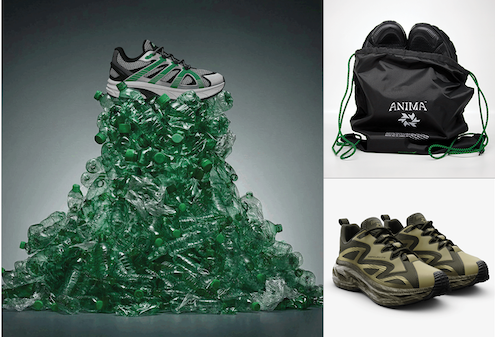


There are 24 billion pairs of sneakers made every year. 95% of those end up in landfills or incinerated. Sneakers are notoriously difficult to recycle. A typical pair can contain dozens of different materials — EVA foam, rubber, polyester, nylon, plastics, and more – bonded together with adhesive, prohibitively expensive and labor intensive to separate and recycle.
Most footwear brands that advertise the use of recycled materials incorporate them into only selected elements, often the mesh upper, while retaining conventional EVA midsoles and rubber outsoles. Those individual materials may be recyclable on their own, but once assembled into a sneaker, it becomes a far more complex problem. It costs more to deconstruct a sneaker than it does to construct one.
A new sneaker company, however, ANIMA, has just launched a 100% recyclable sneaker, by reinventing the process and the materials from which a sneaker is made. “Most companies are trying to solve it at the end, once the product has already been made”, said Andy Griffiths, Chief Commercial Officer and co-founder of ANIMA, in a recent interview with STYLE of SPORT. “We came at a closed loop solution from the beginning of the problem.”
Wear. Shred. Remake. That’s the concept behind ANIMA, a new design-led footwear brand engineered so that every part can be shredded, melted down into pellets, and remade into a 2nd generation shoe using the same material. ANIMA has constructed the entire shoe from mono-material base with the invention of ESTERE™, created from recycled plastic bottles and polyester textiles. With 10 global patents supporting its material and manufacturing innovations, ANIMA has developed ESTERE™ into multiple formulations capable of performing the distinct functions and components of a sneaker.
“The consumer doesn’t buy a sneaker because it’s recyclable”, says Griffiths. “They buy it because they think it’s cool, they like the style, and they have an emotional connection to it. It was really important for us to design a sneaker that could stand on its own, even if you took the sustainability story away.”
ANIMA’s technology originated approximately three and a half years ago when Griffiths’ partner, George Yang, ANIMA’s CEO and Co-Founder, was introduced to Dr. Wayne Wu, a scientist formerly with Taiwan’s Industrial Technology Research Institute (ITRI) — the pioneering research organization instrumental in building Taiwan’s semiconductor industry. At his first meeting with Dr. Wu, Yang was shown something neither founder had seen before: an entire shoe created from a single newly invented material system.
Through changes in its formulation and density, ESTERE™ can be transformed into the different parts of the shoe. The upper, midsole, and outsole are all made from the same recycled polyester-based material system. At the end of its life, the sneaker can be shredded as a whole, no separation required, melted into pellets, and remade into second-generation midsoles and outsoles for future ANIMA sneakers. The entire system is called 4EVERLOOP™ — the logo displayed at the back of the heel.
Perfecting the midsole, the primary cushioning and support component of a sneaker, took more than 17,000 prototypes. Under conventional manufacturing practices, those discarded samples would have become production waste. ANIMA simply melted them back into pellets and used the material again. “We have not wasted a single midsole in the creation of those 17,000,” says Griffiths. “Every pellet gets recompounded and put back into production. We believe this is the future of midsole manufacturing.”

FROM A WATER BOTTLE INTO AN ANIMA OUTSOLE
WATCH THE VIDEO HERE
And so the founders are making ESTERE™ and the 4EVERLOOP™ system available to other footwear companies as well. “When I sit down with another sneaker brand, I ask, ‘Can any of your shoes be recycled into a new-generation midsole with the same performance attributes as the original?’ The answer is no,” says Griffiths. “Ours can.”
Beyond production waste, ANIMA has addressed the other end of the problem: what happens when the consumer is done with their shoes. Through ANIMA’s take-back program, customers can return sneakers in any condition. Using the recyclable drawstring bag that comes with the shoes, customers can print a complimentary return label from the website, place the bag in a shipping envelope, and send the sneakers back for processing. Every customer who returns their used ANIMA sneakers receives $20 off their next pair.
“It has to be easy, free, and frictionless,” Griffiths says. “The challenge is changing that moment when someone would normally throw a sneaker away into: ‘I’m going to send this back to ANIMA, and ANIMA is going to make a second-generation sneaker from it.’”
The closed-loop system is technologically impressive, but ANIMA’s founders are clear that recyclability alone will not make the brand successful. Yang and Griffiths both came to ANIMA from the fashion world and understand the consumer doesn’t buy a sneaker because it’s recyclable. Says Griffiths, “They buy it because they think it’s cool, they like the style, and they have an emotional connection to it. It was really important for us to design a sneaker that could stand on its own, even if you took the sustainability story away.”
The brand has launched with two unisex lifestyle silhouettes, Atomic and Mercury, designed as everyday fashion sneakers rather than specialized performance shoes. They are offered in five colorways each “We designed sneakers we wanted to wear. George is a fashion designer, and we landed on silhouettes and colors that felt relevant to the market and recognizable to the customer. Even though the brand is new, there are elements of the shoes that feel familiar.”
That recognition is important. Shoppers may appreciate the environmental mission, but ANIMA is still competing with the most established footwear brands in the world. “No one gives you a pass because you’re trying to do something better,” Griffiths adds. “The customer is still judging you against the best sneaker brands in the market.”
It is perhaps ANIMA’s most compelling premise: sustainability should not require sacrifice. The circular technology may be what differentiates the brand, but style, comfort, and desirability are what can allow that innovation to scale.
ANIMA was created both as a consumer brand and as proof of concept — a physical demonstration that a stylish, wearable sneaker can be manufactured with virtually no production waste and recycled into a new shoe. The next pair is made from the last one.
That is a footprint worth leaving behind.


